
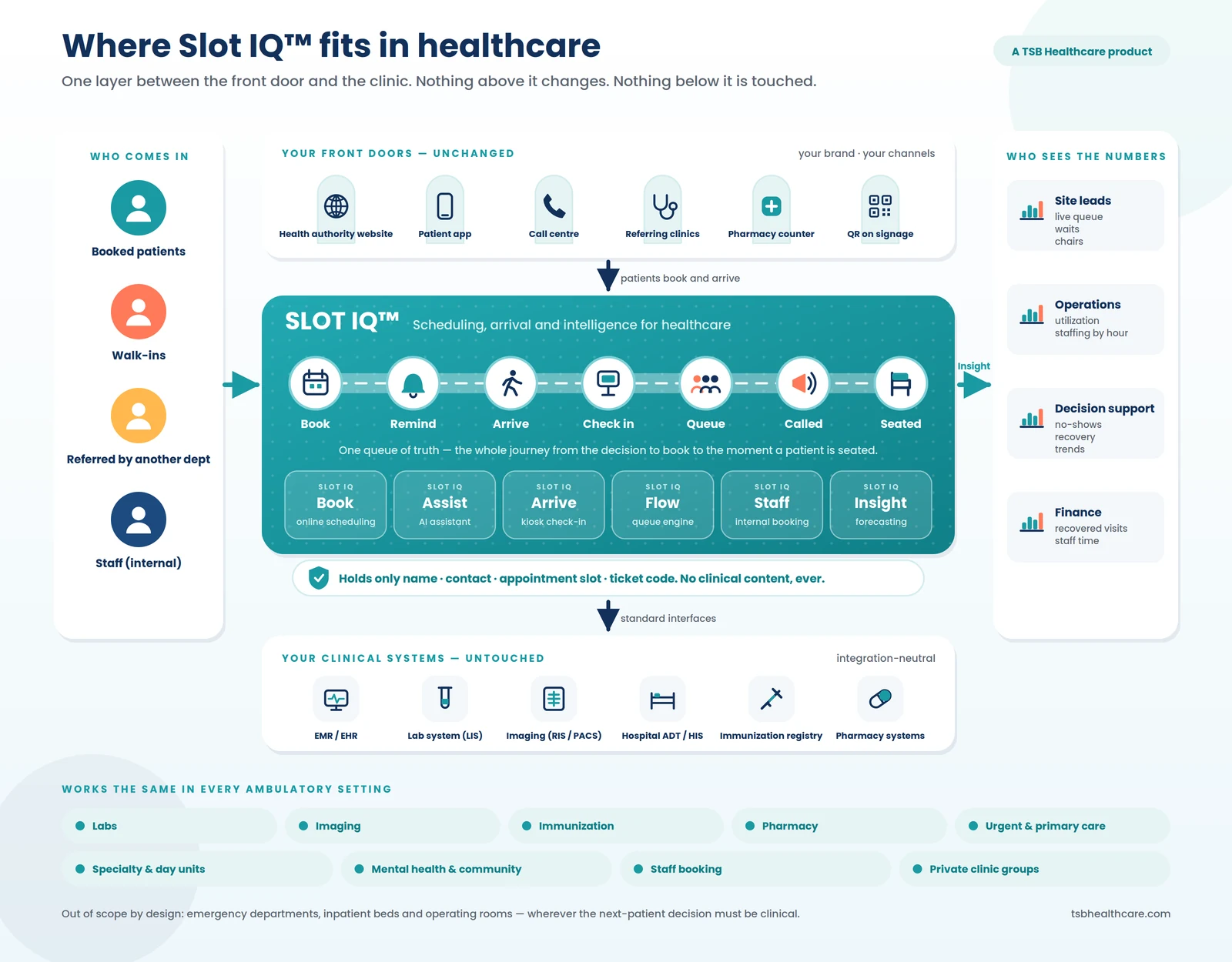
Slot IQ™ — Scheduling, arrival and intelligence for healthcare.
Slot IQ is a scheduling, arrival and intelligence platform for outpatient and ambulatory healthcare. It runs everything between the decision to book and the moment a patient is seated, with six modules on one queue; it serves four BC health providers across 69 sites and has booked more than 4 million appointments.
Every health system has appointments it cannot fill and patients it cannot fit in.
Outpatient labs, immunization clinics, imaging and specialty clinics all run on the same broken arithmetic: a schedule built weeks ahead, a lobby full of people who arrived at the wrong time, no-shows nobody notices until the chair has sat empty, and walk-ins waiting on a clipboard. Where fees are fixed by a public payer, margin comes from throughput and cost, so every empty slot and every extra front-desk hour hits the budget directly.
| The problem | Why it matters to the owner | What Slot IQ does |
|---|---|---|
| 1. Every site arrives with its own front door. | Integration stalls at the phone and the booking desk. Patients see a different experience at every site. | One booking link and one patient experience across every site, online or by QR code. Each new site is configured as a location, not a custom build. |
| 2. Demand piles up at some sites while others sit idle. | Idle capacity is revenue, or public capacity, that never comes back. Overloaded sites lose patients. | Patients see open times across nearby sites with an earliest-available search, so demand moves toward capacity. |
| 3. Front-desk labour is the largest cost you can control, and the hardest to hire. | Phone booking ties up trained staff. Turnover and wage pressure grow with every site added. | Patients book and cancel themselves, with email and SMS reminders. Staff time shifts to patients in the building. |
| 4. No-shows and cancellations leave prepared slots empty. | Every missed slot is staffed cost with no revenue. It rarely gets recovered because nobody sees it in time. | Slot IQ Flow releases the slot and offers it to a waiting patient in real time; the patient gets a one-tap rebook link. |
| 5. Walk-ins are invisible and lobbies run on paper. | No count, no wait estimate, no honest answer at the door — and no-show and wait figures cannot be trusted. | Kiosk check-in records every arrival. The kiosk gives walk-ins an honest answer and a ticket, and every wait is measured. |
| 6. There is no clean, comparable operating data across sites. | Hard to benchmark sites, find the bottlenecks, or prove the improvement. | Site-by-site reporting on volume, utilization, no-shows, waits and recovery from day one, with export. |
Six modules. One queue of truth.
Slot IQ™ is designed, built, hosted and supported in Vancouver, British Columbia, by TSB Healthcare. Each module works on its own and gets better when combined. All of them write to the same event log, which is what lets Slot IQ™ improve week over week.
| Module | What it does | Who uses it |
|---|---|---|
| Slot IQ Book | Multi-site online scheduling with one search across every location — earliest available, nearest, or the site that offers the service — plus capacity rules per site and hour, requisition upload, group and family bookings and rebooking links. | Patients, call centres, referring clinics |
| Slot IQ Assist | An AI assistant that books, reschedules and navigates: which site offers the service, where the earliest slot is, what to bring, how to prepare, where to park, how long the wait is — in the patient’s own language, by chat or SMS, from the provider’s own approved content. Never clinical advice. | Patients, front-desk staff |
| Slot IQ Arrive | Kiosk check-in by QR code, booking code or walk-in registration; ticket codes; a waiting-room display that calls tickets to rooms; SMS wait bands. | Patients, reception |
| Slot IQ Flow | The queue engine. One pooled queue for every room, a fixed dispatch rule, automatic release and refill of no-show slots, walk-in feasibility at the door, department slot-ins from other clinics. | Site leads, phlebotomists, nurses |
| Slot IQ Staff Ask about staff booking | Internal booking for staff across sites: occupational health, vaccination campaigns, training and testing, on the same capacity engine. | Occupational health, HR, program leads |
| Slot IQ Insight | Live and historical analytics, demand forecasting by hour, no-show and service-time prediction, and the feedback loop that retunes each site’s parameters from its own data. | Operations, decision support, finance |

Behind your front door
Slot IQ is the scheduling and arrival layer, not a new patient portal. Your brand, your channels.

PHI-minimal by design
Name, contact and appointment slot only. No clinical content, which keeps privacy assessments light.

Integration-neutral
Works alongside any EMR, LIS or hospital information system through standard interfaces.

Institution-pays
Patients are never charged. Pricing is per site or per visit, aligned to the capacity it recovers.
Keep it light and simple.
Slot IQ does one job: it knows who has arrived, where they are in the flow, and who is next. It does not need to know why a patient is there. We take no clinical information — no requisitions, no results, no diagnoses, no notes. A booking is a name, a way to reach the patient and a time slot. A visit is a ticket code and a place in the queue.

No clinical content
Nothing about the patient’s health passes through Slot IQ. Clinical systems stay where they are, untouched.

Light to assess
Name, contact and slot only. Privacy impact and security assessments have been completed at four BC health organizations on exactly this footprint.

Simple to adopt
Patients book without an account, in their own language, and check in with a QR code. Staff learn the dashboard in an afternoon.

Simple to explain
One fixed queue rule, visible to everyone. Any patient can be told why they were called when they were.
Any setting where patients arrive, wait and are called.
The engine is not lab-specific. It fits any outpatient or ambulatory service with bounded visits, booked or walk-in.
| Setting | Examples | Why it fits |
|---|---|---|
| Diagnostics | Outpatient labs, imaging (X-ray, ultrasound, mammography, CT, MRI), ECG, screening programs | Booked plus walk-in, fixed rooms, high no-show sensitivity; live today for labs |
| Public health and pharmacy | Immunization campaigns, flu and travel clinics, pharmacist prescribing and minor-ailment visits | Registration, injection and observation stages behave as a queue network |
| Primary and urgent care | Urgent and Primary Care Centres, community health centres, walk-in clinics, student health | The booked-plus-walk-in pattern with the most visible public wait pressure |
| Specialty and day units | Specialty clinics, pre-admission and pre-surgical clinics, infusion and dialysis chairs, rehab and physio | Chair-based, session-length services where a missed slot is a lost session |
| Mental health and community | Intake, counselling, community programs | High no-show rates; PHI-minimal design suits sensitive settings |
| Staff and internal | Occupational health, fit testing, training and testing, campaign booking across sites and school districts | Same capacity engine, internal users |
Deliberately out of scope: emergency departments (arrival order is overridden by clinical triage), inpatient beds, operating rooms and home care. Where the next-patient decision must be clinical, Slot IQ stays out of it.
Live in days, not months.
Slot IQ is configured, not built. A new site is a location with hours, rooms, services and capacity rules — the same platform that already serves 69 sites and four organizations without a custom build for any of them. Adding a site to an existing customer takes a day. Bringing a new organization live takes about a week of our time and a few hours of yours.
| When | What happens | Your time |
|---|---|---|
| Day 1 | Sites, hours, rooms, services and capacity rules configured from your existing schedule. Your branding, wording and reminder templates applied. | A one-hour working session |
| Days 2–3 | Booking links and QR codes issued for your website, app, call centre and signage. Reminder and cancellation flows tested with your team. | Review and sign-off |
| Days 3–5 | Staff trained on the portal and, for Slot IQ Flow sites, the live dashboard and room tablet. One afternoon per site; no manual needed. | One afternoon per site |
| Go-live | Patients start booking. Reporting runs from the first day, so your baseline is measured before anything else changes. | None — we monitor |
| Kiosks and queue engine | Kiosk and display hardware is supplied and installed by TSB Healthcare; the queue engine is switched on per site once arrivals are being recorded. | Site access and a power outlet |
What we need from you

Sites and hours
A list of locations, opening hours and rooms or chairs per site. A spreadsheet is fine.

Services and durations
The services patients book and how long each takes. Existing schedules are the starting point.

Branding and wording
Logo, colours and any required wording for patient-facing screens and reminders.

One decision-maker
A single contact who can sign off on configuration and the go-live date.
Two phases complete, one live, one in pilot.
Online booking has run at provincial scale since 2018, the AI booking assistant went live in May 2026, and the arrival and queue engine — the full loop from booking to seat — is now in pilot at British Columbia sites.
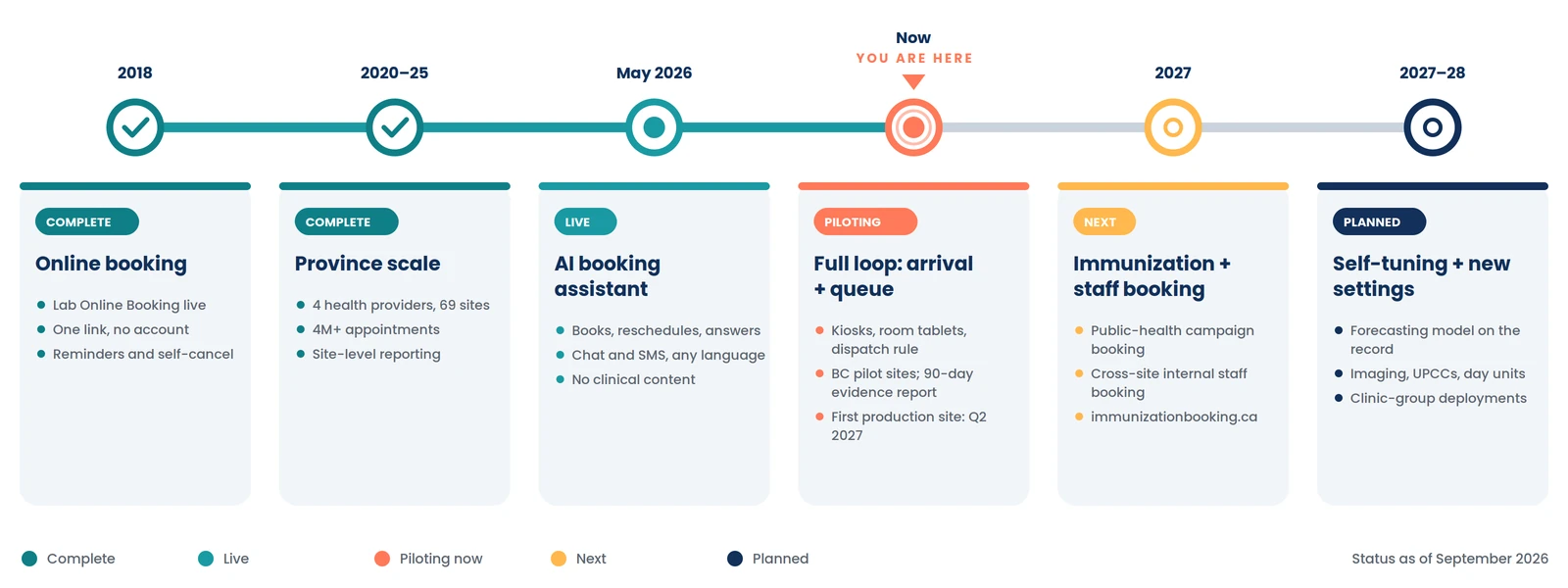
- 2018 — Complete: Online booking. Lab Online Booking live; one link, no account; reminders and self-cancel.
- 2020–25 — Complete: Province scale. Four health providers, 69 sites, 4M+ appointments, site-level reporting.
- May 2026 — Live: AI booking assistant. Books, reschedules and answers; chat and SMS, any language; no clinical content.
- Now — Piloting: The full loop, arrival and queue. Kiosks, room tablets and the dispatch rule at BC pilot sites; 90-day evidence report; first production site targeted for Q2 2027.
- 2027 — Next: Immunization and staff booking. Public health campaign booking, cross-site internal staff booking, immunizationbooking.ca.
- 2027–28 — Planned: Self-tuning and new settings. A forecasting model on the record; imaging, UPCCs and day units; clinic-group deployments.
What “piloting the full loop” means
Pilot sites are instrumented with kiosks, room tablets and the queue engine running its rules-based dispatch. Each pilot runs 90 days and closes with an evidence report on the six numbers shown on the engine page. We claim no result until that report is in; the first production site is targeted for Q2 2027.
| Now | Next | Then |
|---|---|---|
| Lab scheduling at scale; kiosk check-in and queue engine pilots; AI booking assistant; live analytics | Immunization and staff booking; per-site forecasting and self-tuning parameters; clinic-portfolio deployments | Imaging, Urgent and Primary Care Centres, specialty clinics, infusion and day units, pharmacy on the same capacity engine; cross-site capacity marketplace within a health system |
Lab Online Booking: one system, an entire province
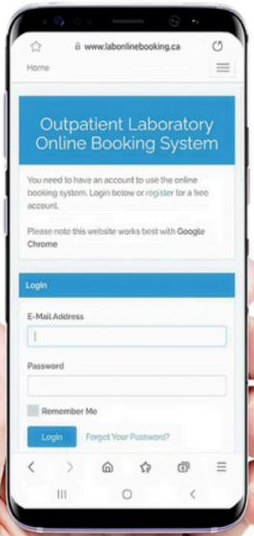
Lab Online Booking (LOB) is the outpatient laboratory scheduling service TSB Healthcare has operated for British Columbia since 2018. It runs on Slot IQ™, across 69 sites run by four separate health providers. Read the full Lab Online Booking case study or visit labonlinebooking.ca.
* Staff-time estimates assume about 5 minutes of staff phone time per online booking at $35/hour. Figures come from Lab Online Booking platform reporting (data through November 2025) and are rounded. Health providers are not named to respect client confidentiality.
Privacy and security record
Privacy and security assessments are the long pole in any health-provider deployment. Ours are already done: vendor sections of Privacy Impact Assessments and Security Threat and Risk Assessments completed at four BC organizations, and a third-party penetration test in 2024. New customers reuse them rather than starting from a blank form. Because the platform holds no clinical content, the assessment scope stays narrow and the review stays short.
Simple enough for a seven-year-old or a seventy-year-old.
Three in four bookings on the platform are made by patients themselves, across every age group and in the languages British Columbians actually speak.

No account, no app
Patients book from a link or a QR code on any phone or computer. Nothing to download, no password to remember, no login to recover.

Four taps to a booking
Choose a service, see open times across every nearby site in one search, pick the earliest or the closest, enter a name and phone number. Confirmation by text, one-tap cancel or rebook.

Check in in seconds
Scan the QR code from the reminder text or type a short booking code at the kiosk. A ticket code, an estimated wait, and permission to wait anywhere.

Plain language, large type
Every screen is written at a grade-6 reading level, with large type, high contrast and no jargon.

In the patient’s own language
The AI assistant books, reschedules and answers questions in Punjabi, Cantonese, Mandarin, Tagalog, Farsi, Korean, Spanish, Arabic, Vietnamese and dozens more — by chat or SMS, with no interpreter and no waiting.

For the people who can’t
A companion or a staff member can book and check in on someone’s behalf. The call centre and front desk use the same system, so a phone booking is never a different path.

For staff
The dashboard shows one thing: who is next and why. Staff learn it in an afternoon and the fixed queue rule means they can explain every call to a patient in one sentence.
For the lobby
The public display calls ticket codes only, never names, in large type. Patients waiting elsewhere are texted when it is their turn.
The proof is in who uses it: 71% of all bookings in 2025 were made by patients themselves, up from 63% in 2021 — and at the best-performing provider it is 99%. Adoption grows every year without any patient training. (Source: Lab Online Booking platform reporting, 2025 data through late November.)
A queue engine that keeps every chair busy and keeps every promise.
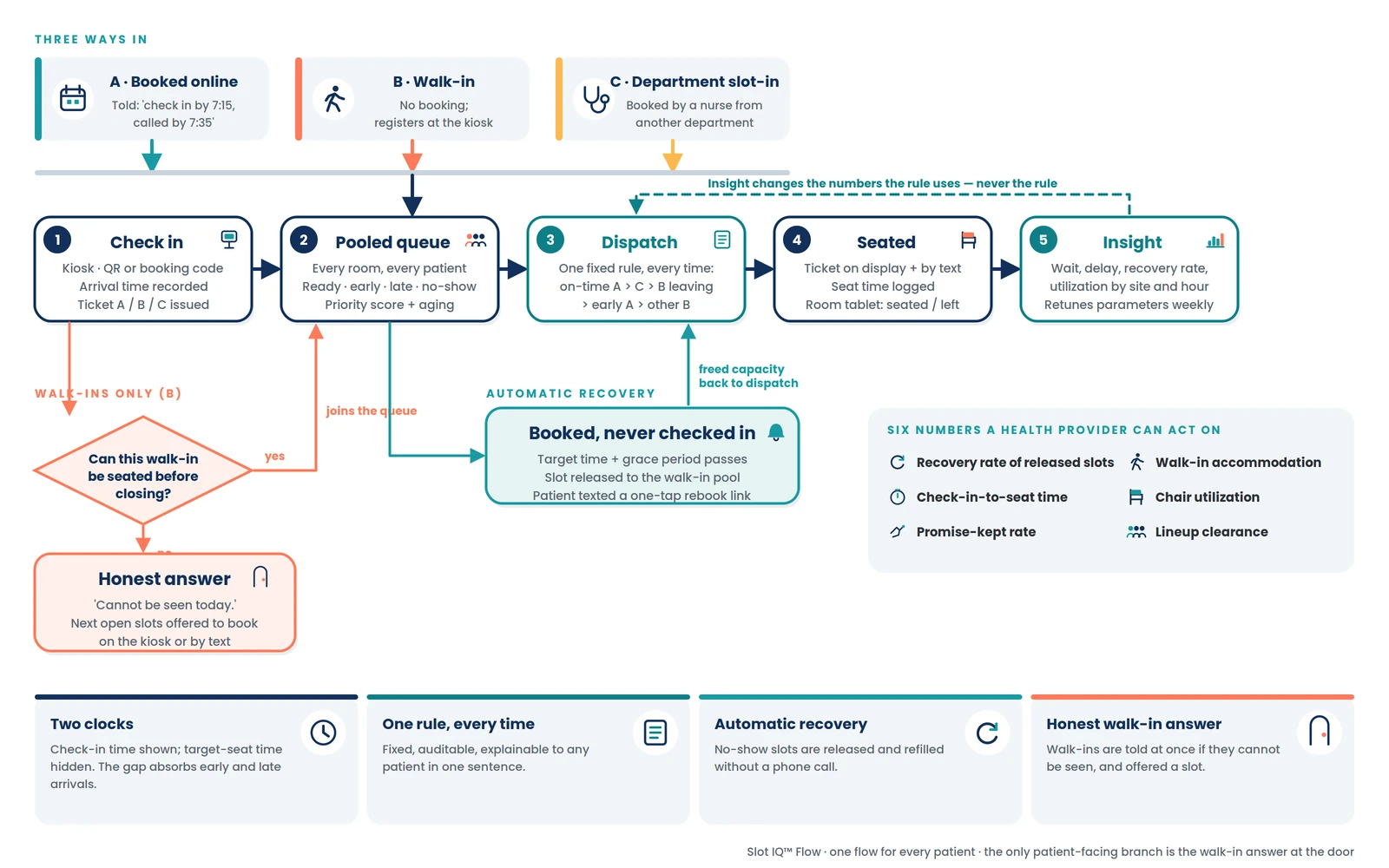
One dashboard for staff. One code per patient. No names on screen.
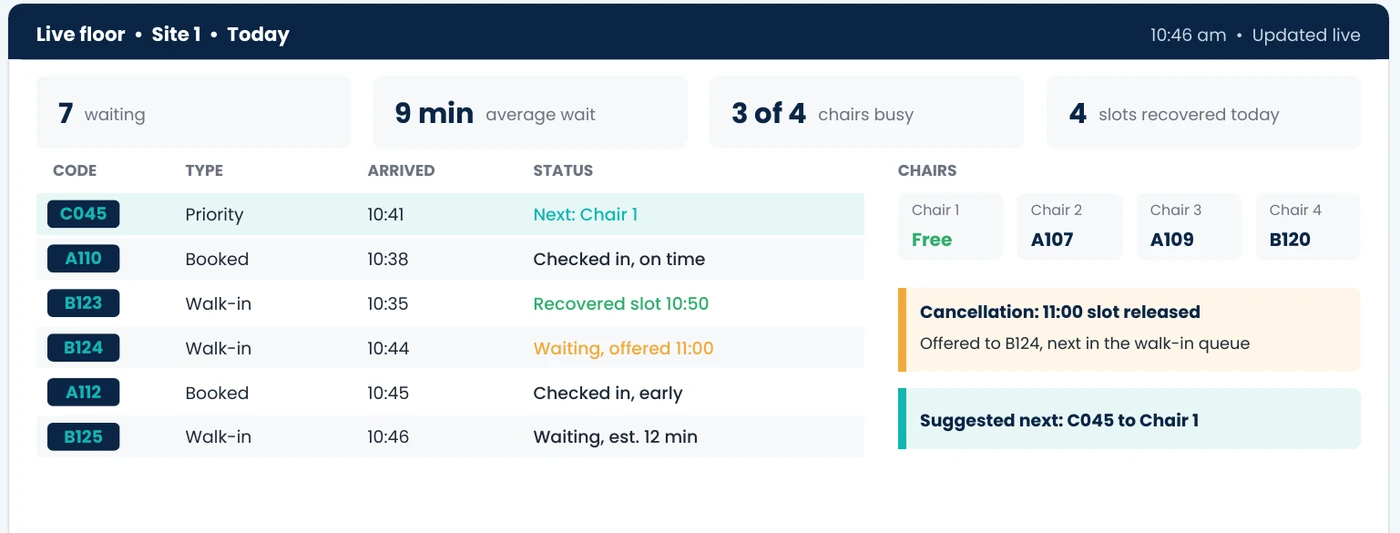
Staff run the day from one live view: who is waiting, who is next and why, which chairs are free, which slots have been recovered. Every patient gets one code at check-in — A for booked, B for walk-in, C for department slot-in — on the display, in text updates and on the dashboard.
Walk-ins are first-class, not an afterthought
A walk-in taps “No booking” at the kiosk, enters a name and phone number, and gets a B-series ticket. Before the ticket is issued, Slot IQ Flow checks whether the patient can be seated before closing; if not, the kiosk says so at once and offers the next open slots to book on the spot. Walk-ins then join the same pooled queue as booked patients, ranked by one fixed rule, and are texted a wait band so they can wait anywhere. A released no-show slot goes to the next walk-in automatically.
Where AI fits, and where it does not
Slot IQ Assist talks to patients — and guides them. It books, reschedules and navigates, in the patient’s own language, answering only from the provider’s approved content and the live schedule. Anything clinical is referred to the lab or the patient’s doctor. Slot IQ Insight predicts and measures: per site and per hour it forecasts walk-in demand, service times and no-show probability, and retunes each site’s buffer, grace, overbooking factor and staffing by hour from that site’s own data every week.
Dispatch is a rule, not a model. Neither ever decides who is called next. Models change the numbers the rule uses; they never change the rule — so a health authority can explain every call in one sentence and AI-governance reviews stay simple.
Built on published research and tested before it ships
Slot IQ Flow was designed from the published literature on appointment scheduling, queueing theory and patient behaviour, then tested by simulation before it reaches a site. Each pilot closes with an evidence report, and we claim no result until it is in.
Explainable by design
Any patient can be told why they were called when they were. Slot IQ uses one fixed, visible rule instead of a score nobody can explain.
Honest wait estimates
Waits are quoted as a range, and when an estimate cannot be worked out the screen says so instead of showing a misleading number.
Rules decide, models predict
Predictions can change the numbers the rule uses. They never change the rule, so every call can be explained in one sentence.
| Research area | Published source | What it means in Slot IQ |
|---|---|---|
| Appointment scheduling | Bailey, Journal of the Royal Statistical Society B, 1952; Sickinger and Kolisch, Health Care Management Science, 2009 | The classical starting point for how outpatient bookings are spaced; it shapes how Slot IQ treats booked time and walk-in time. |
| Same-day capacity | Murray and Berwick, JAMA, 2003 | Holding capacity for same-day demand. In Slot IQ, a released slot is offered to a waiting patient the same day. |
| Reminders | Guy et al., Health Services Research, 2012 (meta-analysis) | SMS reminders raise attendance. With one-tap cancel, a cancelled slot returns to the schedule instead of sitting empty. |
| Queueing theory | Little, Operations Research, 1961; Kingman, Mathematical Proceedings of the Cambridge Philosophical Society, 1961 | Waits grow sharply as a room nears full use, so Slot IQ measures utilization and waits by site and hour. |
| Pooled queues | Mandelbaum and Reiman, Management Science, 1998; Song, Tucker and Murrell, Management Science, 2015 | Pooling helps when visits are similar and can hurt when they are not. Slot IQ pools short, similar visits and measures the result in every pilot. |
| Perceived wait | Thompson et al., Annals of Emergency Medicine, 1996 | Information shapes satisfaction as much as the wait itself, so patients see their place and a wait range. |
| Vaccination queues | Hanly et al., BMC Health Services Research, 2022 | Mass-vaccination sites behave as queue networks, which informs Slot IQ’s immunization configuration. |
Study findings are the studies’ own. Slot IQ deployment figures are reported only from instrumented sites under contracted reference rights.
One platform, three settings.

Health authorities
Recover lost outpatient capacity without new staff. Deploy behind existing channels, on a PHI-minimal footprint, through pilot and procurement pathways designed for public-sector integrity. Extend from labs to immunization, imaging and clinics on the same engine.

Clinic groups and private equity
Standardize booking, arrival and queueing across an acquired portfolio in weeks, not per-clinic projects. Same-day capacity visibility across every site, one analytics layer, and a throughput metric that ties directly to revenue per room.

Public health and pharmacy
Campaign-scale immunization booking with observation-seat capacity built into the model, walk-in absorption during surges, and internal staff booking across sites and school districts.
A repeatable patient-access playbook for every site

Baseline
At close / go-live: measure phone volume, utilization and no-shows at each new site before anything changes.

One front door
First 100 days: move the site onto the shared booking link and reminders. Front-desk time shifts from phones to patients.

Recover capacity
Hold period: deploy Slot IQ Arrive and Flow at high-volume sites to fill cancelled and missed slots.

Proof in the data
Exit / review: hand decision-makers comparable, site-level operating data that shows the improvement.
Frequently asked questions
What is Slot IQ?
What are the six Slot IQ modules?
Does Slot IQ store clinical information?
How long does it take to go live with Slot IQ?
Who pays for Slot IQ?
Which healthcare settings does Slot IQ fit?
Does Slot IQ work with our existing EMR or lab system?
Is Slot IQ in production today?
Last updated: October 2, 2026
Let’s find the capacity you already have.
We build around the problem first. We’d welcome a 20-minute conversation about where patient access and flow are hardest across your sites, and whether a measured pilot at one of them makes sense.