
Lab Online Booking: one system, an entire province
Lab Online Booking (LOB) is the outpatient laboratory scheduling service TSB Healthcare has operated for British Columbia since 2018. It runs on Slot IQ™. Patients book lab visits at 69 sites run by four separate health providers — regional health authorities and a faith-based provider, each with its own management, staff and budget — all on one platform: one owner-level view over many sites that operate very differently.
By Young Kim, CEO, TSB Healthcare · Published October 1, 2026 · Updated October 2, 2026
Online booking and self check-in
The same system in very different settings.
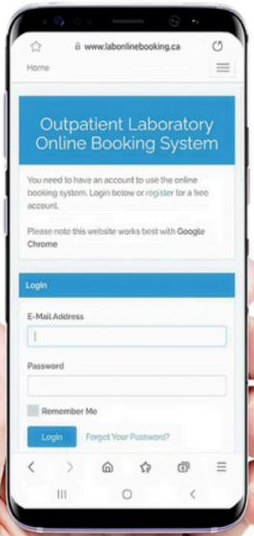
Online booking, in production. The live patient portal at labonlinebooking.ca. One link on any phone, or a QR code on signage. No account required.
Self check-in kiosk. Booked patients scan in; walk-ins register. Everyone gets a code and can wait anywhere.

Dense urban hospitals
High volume, walk-in pressure, tight space.

Growing suburbs
Rising demand and the platform’s busiest sites.

Small rural towns
Dozens of small sites spread across a large region.

Remote coast
Small teams and long trips for patients.
What the province-wide data shows
- Site data finds hidden capacity. No-show rates ranged from under 1% at the best sites to over 12% at the worst. Bringing just two high-volume sites to their network average would recover about 8,500 slots a year.
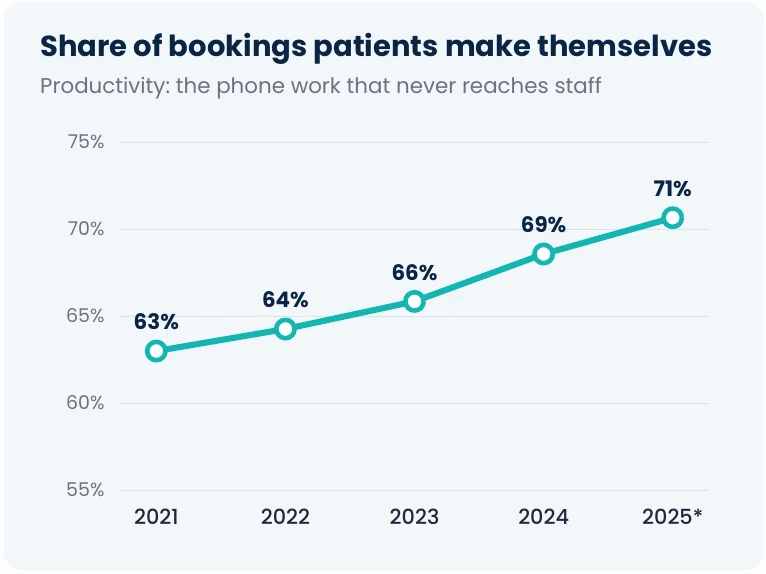
- Self-service varies, and that’s the lever. The share of bookings made online ranged from about 59% to 99% by provider. Every point gained moves phone work off the front desk.
- Owners get one comparable view. Volume, utilization, no-shows and cancellations are reported the same way at every site, so leaders can benchmark sites and act on the outliers.
* Staff-time estimates assume about 5 minutes of staff phone time per online booking at $35/hour. Figures come from Lab Online Booking platform reporting (data through November 2025) and are rounded. Health providers are not named to respect client confidentiality.
Productivity and staff time saved, year after year
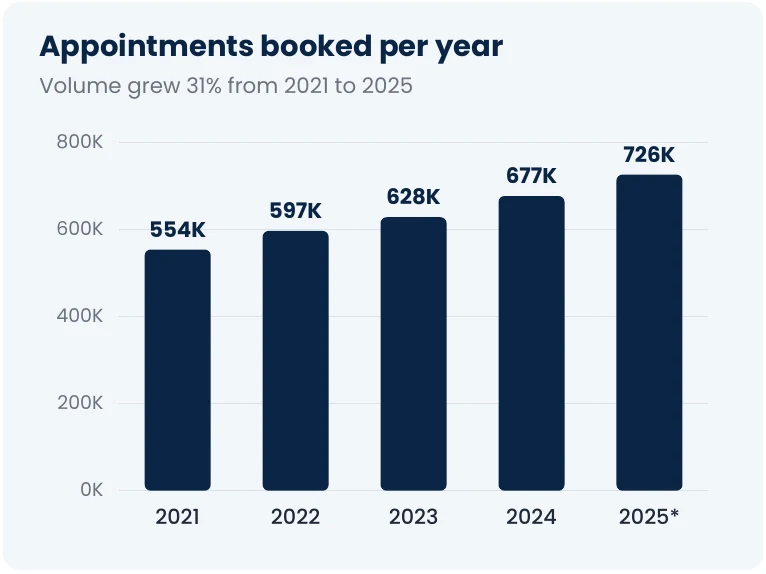
Every booking a patient makes online is a phone call a staff member doesn’t take. Across the platform, that shift has grown every year, and the savings compound as volume grows.
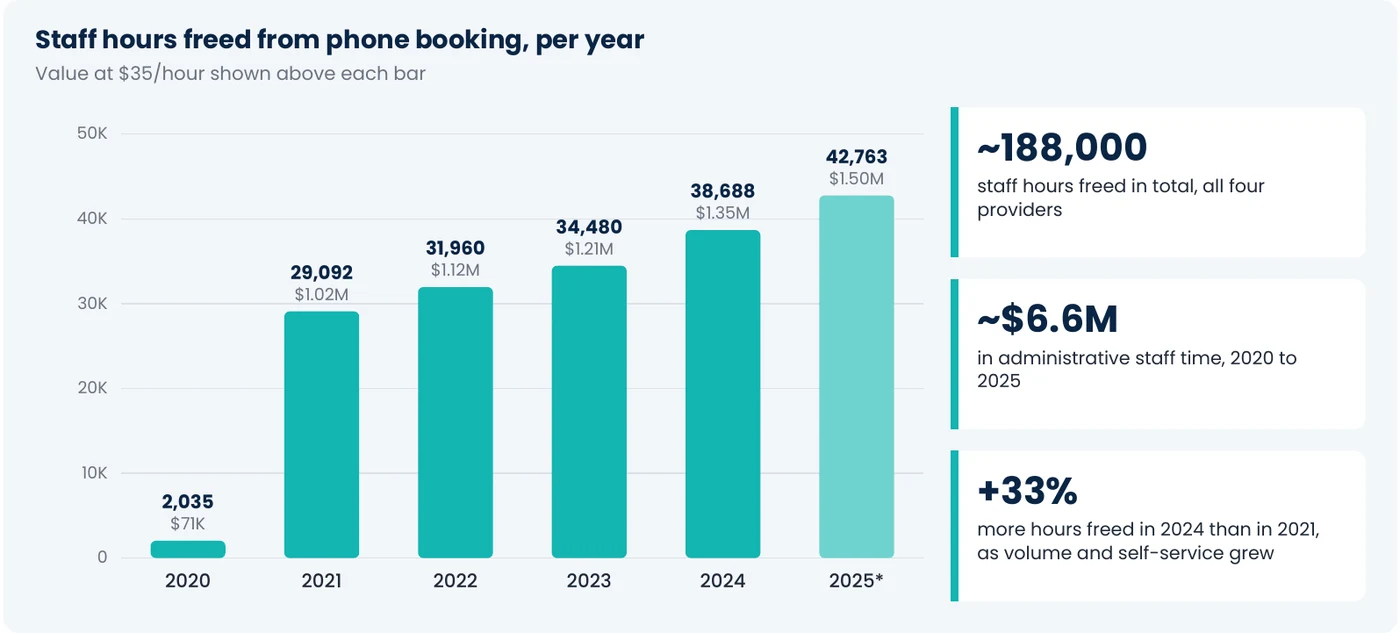
Rule of thumb for a portfolio: every 10,000 bookings moved online frees about 830 staff hours, roughly $29,000 in front-desk time, before counting slots recovered from cancellations and no-shows.
2020 was a partial launch year, and 2025 data runs to late November, so both are partial years. Annual charts cover the three providers with year-by-year reporting, which account for about 95% of online bookings; totals include all four. Staff time assumes about 5 minutes of phone handling per booking at $35/hour. Source: Lab Online Booking platform reporting.
Health Provider A: five years on one booking layer
| Provider | Type | Sites on Slot IQ | Live since | Data period |
|---|---|---|---|---|
| Health Provider A | Urban hospital network | 2 outpatient sites | 2020 | 2020–2025 |
Health Provider A moved both of its outpatient diagnostic sites onto the platform in 2020. Patients book online from one link, see open times at either site, and receive email and SMS reminders. Staff manage the day from a single dashboard.
What changed
- Phone work moved online. About 103,000 bookings were made by patients themselves instead of through a staff phone call.
- Adoption kept climbing. Volume grew from about 5,600 appointments in the first year to about 35,800 in 2025.
- Load stayed balanced. Both sites ran near full, with neither sitting idle while the other was overloaded.
What the data revealed
- A hidden workflow gap. The network’s no-show rate (8.9%) was above the platform average (6.6%). Reporting traced part of it to one site not recording late arrivals as arrived.
- Peak no-show windows. Most missed appointments clustered between noon and 3 pm — a specific window for reminders and overbooking rules.
- Strong retention. 96% of the network’s patients booked only at its own sites.
Patients cross boundaries. Most systems can’t see it.
Because Slot IQ runs across four BC health providers at once, it sees what no single provider’s system can: patients who book wherever there is an open slot — the behaviour a multi-site network wants between its own clinics.
The takeaway: patients who are shown open times at more than one site will use them. These patients also cancelled more often (24.8% vs. 14.0%) because some book backup slots. Reminders and easy self-cancellation return those slots to the schedule instead of leaving them empty — and Slot IQ Flow offers them to the next waiting patient.
Read more about the platform behind it on the Slot IQ™ platform page, or see the live service at labonlinebooking.ca.
Let’s find the capacity you already have.
We’d welcome a 20-minute conversation about where patient access and flow are hardest across your sites, and whether a measured pilot at one of them makes sense.