A patient access center is a centralized operational hub in healthcare where one team manages appointment scheduling, registration and related access tasks for multiple clinics or sites across a health system. It acts as a single point of contact for patients seeking medical services, whether they call, book online or are referred by another provider.
This article is written for patient access and outpatient operations leaders, not for patients or job seekers. It covers practical models and technology choices for centralizing scheduling across outpatient programs.
In most health authorities and large medical groups, the patient access center is the operational home for centralized scheduling, referral booking and inbound calls. Patient access centers manage scheduling and communications between patients and healthcare providers through a shared scheduling engine that can coordinate phone booking, online appointment scheduling and in-person requests. Below, we compare centralized and decentralized scheduling, describe three access models, outline software requirements and use Lab Online Booking as a real-world example.

Core functions of a patient access centre
A patient access centre supports multiple outpatient sites - labs, medical imaging, public health clinics - by carrying out a consistent set of scheduling and registration tasks. Its purpose is to streamline operations across programs while respecting local differences in clinic hours, visit types and eligibility criteria.
Depending on the organization, an access centre may also collect and verify patient demographics before the visit, handle referral intake, and route complex clinical questions back to local clinics when an agent cannot resolve them. Concrete scheduling responsibilities include new appointment booking, reschedules, cancellations, basic referral intake, slot search across locations, reminder management and triage of appointment requests that fall outside standard scheduling rules.
Centralized scheduling teams follow standardized templates and documented rules while allowing local capacity control. The operational goals are clear: improve access, reduce call abandonment, protect staff time at individual offices and provide a consistent patient experience whether patients call, book online or are booked by staff members at another clinic.
Governance typically sits with patient access, outpatient operations or diagnostic services leadership. The central department coordinates with site managers and clinical leads through regular review of scheduling parameters, template changes and performance improvement targets.
Centralized vs decentralized scheduling: key differences
Centralized scheduling means one team or engine manages patient appointments across many sites. Decentralized scheduling allows individual departments to manage appointments separately, each with its own phone number, templates and booking rules. Many healthcare organizations land on a hybrid model, combining centralized and decentralized scheduling depending on service line, complexity and local readiness.
The pain points of decentralized scheduling are familiar: multiple phone numbers for patients to navigate, duplicated scheduling templates, uneven application of rules, limited visibility into system-wide capacity and difficulty improving access consistently. Clinic managers spend time solving local problems that a central team could handle once.
The benefits of centralizing come from doing that work once. One set of rules is applied the same way everywhere. Capacity at every site is visible in one place, so an open slot at one clinic can be offered to a patient who would otherwise wait at another. Patients have one number or one booking page instead of many. And a cancelled appointment can be released and offered to the next patient straight away, instead of going unused.
Central scheduling does not require one physical office. A centralized scheduling team can work remotely from several locations into a single centralized scheduling system.
Comparing the three scheduling models
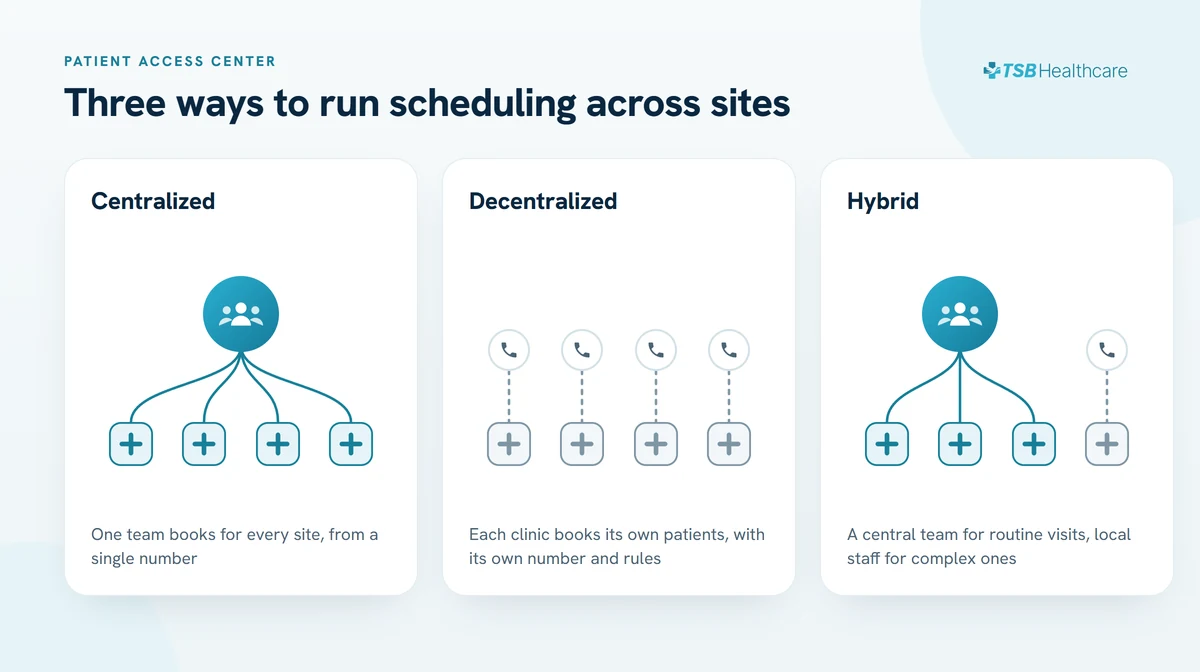
The table below compares three scheduling models across criteria that matter most to operations leaders.
Criterion | Centralized scheduling | Decentralized scheduling | Hybrid model |
|---|---|---|---|
Who books | One team handles patient scheduling across sites | Local staff at each clinic or department | Central team owns routine visit types; local staff handle complex or specialty bookings |
Phone access | Single number or unified routing | Multiple numbers per clinic | Central number for most; local for exceptions |
Scheduling rules and templates | Standardized templates with scheduling parameters defined centrally | Rules vary widely across individual offices | Core rules centralized; local overrides where needed |
Visibility into capacity | System-wide, real-time view of availability | Limited to each clinic's own schedule | Good for centralized parts; local parts may lag |
Governance and buy-in | Requires strong buy-in from clinical leaders and provider champions to standardize | More local autonomy but less consistency | Balanced: central team sets the baseline, local leaders keep control of complex areas |
Surge handling | Easier to shift appointment volume across staff and sites | Each clinic constrained to its own capacity | Central team absorbs the baseline; local teams handle specialty surges |
A patient access centre typically sits on the centralized or hybrid side of this spectrum. In practice, high-volume outpatient services like labs and imaging tend to centralize first, while multi-location practices with highly variable visit types may keep local scheduling until templates and rules are agreed.
Three patient access models: agent, self-scheduling and hybrid
Centralized vs decentralized scheduling is not the only decision. Leaders also choose among three models of access: an agent-based access centre, centralized online self-scheduling, or a hybrid of both. In large health authorities and medical groups, different diagnostic programs may adopt different models over time. A regional lab network, for example, may standardize on online scheduling while a medical imaging program keeps an agent-led patient access platform for complex modalities.
Agent-based patient access centre
In an agent model, patients reach a single phone number and speak with access representatives who use a centralized scheduling system to search capacity across clinics, apply scheduling rules and book appointments. This model fits best where visit types are complex, referrals must be validated, or a high proportion of patients prefer phone access over online appointment scheduling.
Operational requirements include standardized templates with defined appointment lengths, written provider and modality rules, training for the centralized scheduling team, scripts for common scenarios, and a clear escalation path back to clinicians or site managers. Advantages include strong control over booking quality and the ability to balance call volume across agents. Tradeoffs include staffing costs and the risk of long queues if inbound calls spike.
Many organizations start here as they centralize the scheduling process, then layer online self-scheduling over the same engine once rules are stable and provider champions are on board.
Centralized online self-scheduling
Centralized online self-scheduling lets patients book directly into open slots using shared rules that apply consistently across participating sites. The booking tool typically sits behind the health system's website or online appointment booking pages and draws from the same centralized scheduling system agents use.
Lab Online Booking in British Columbia is a concrete example. It started in 2018 at a single Vancouver Coastal Health lab. Since then it has booked more than 4 million appointments for more than 820,000 patients, and 3 in 4 bookings are made by patients themselves. Lab Online Booking is the BC case study and the online booking part of Slot IQ, not a separate commercial product.
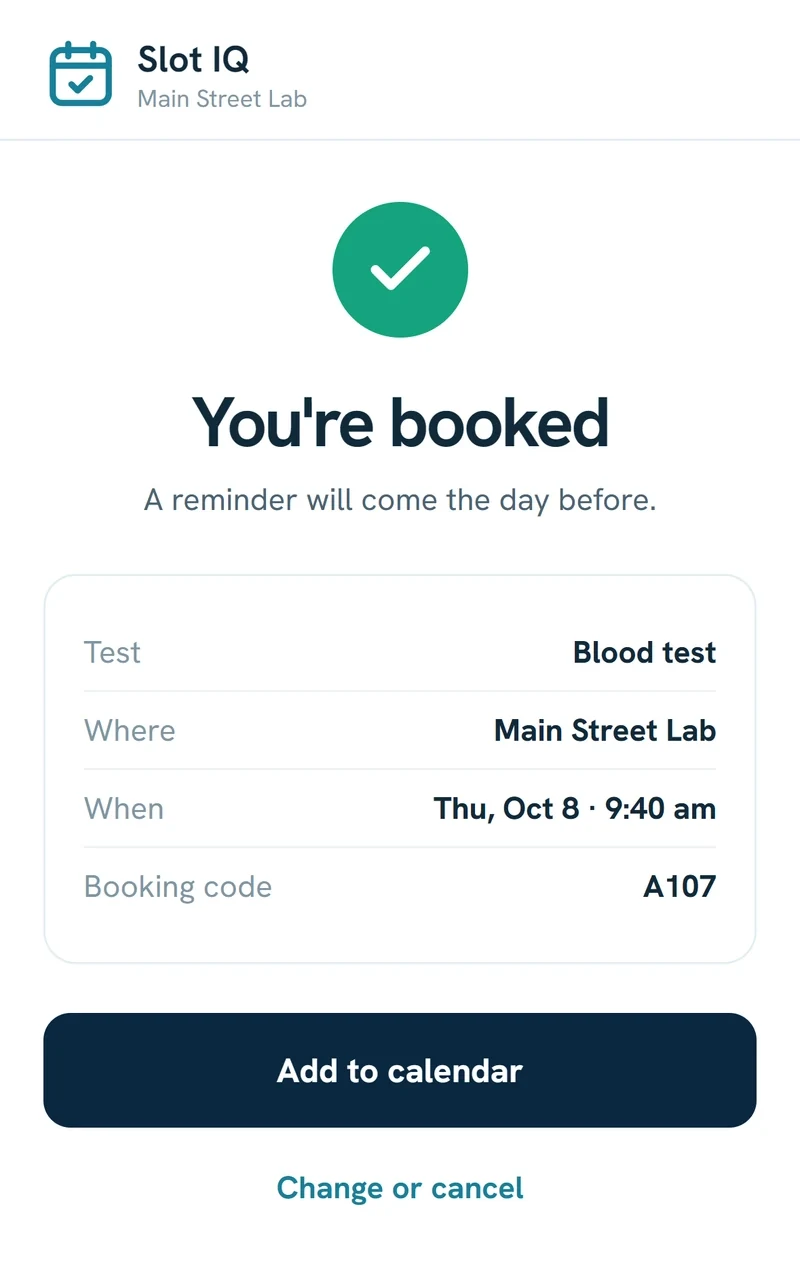
This model fits best for high-volume outpatient services - lab, medical imaging, immunization - with well-defined visit types where leadership wants to improve access and shift routine appointment scheduling off the phones. It requires agreed scheduling templates, clear site rules and a mobile-friendly patient interface.
Hybrid access models
A hybrid model combines a centralized scheduling team handling complex visits by phone with online booking for routine, low-risk visit types. Access centre agents focus on exceptions, multi-step bookings and patients with access barriers. Online booking covers straightforward follow-up labs, screening mammograms or public health clinics.
Northern Health's lab outpatient program, a 2024 BC Quality Awards winner, is one public example of this approach (it is not a Slot IQ deployment). According to Health Quality BC, it modernized lab services across 26 sites with a blend of scheduled and unscheduled appointments, online or phone self-scheduling, and drop-in queuing. Over time, organizations often move more visit types from agent-only to hybrid or self-scheduling as rules mature and clinical leaders gain confidence that patient care is not compromised.
When each access model fits: practical scenarios
Many healthcare organizations use more than one model at once, selecting by program and readiness.
A regional lab network standardizing on online booking for routine blood work. High appointment volume, low variability, patients comfortable booking online. A new patient can find the nearest site and book in minutes.
A medical imaging program using an agent-led access centre for MR and CT. Modality restrictions, safety screening and referral management require human review before booking.
A public health immunization program using a hybrid model during a time-limited campaign. Routine vaccine appointments go through online scheduling; agents support outreach and eligibility exceptions.
A health authority with both urban and rural settings. Urban labs adopt self-booking; rural sites keep agent-based or hybrid options to accommodate connectivity and patient preferences.
Decision criteria include variability of visit types, need for clinical review before booking, patient demographics, regulatory requirements and existing investments in call centres. To build buy-in, involve program directors, local clinic managers and medical leaders early. Share baseline metrics - call abandonment, third next available appointment, patient satisfaction - and patient feedback. Define specific, measurable goals before launch.
Whatever model is chosen, patients should see one coherent experience: find appointments easily, receive clear instructions and avoid redundant calls.
Software needs of a modern patient access centre
Shifting to centralized scheduling or a hybrid model requires more than staffing changes. It needs patient scheduling software that every channel can use.
One search across sites. Agents and patients should find the right appointment by location, date range, modality, provider or visit type in a single view.
Shared rules with local capacity. The platform encodes visit types, prerequisites, age or modality limits and local clinic hours, while giving each site control over its scheduling templates.
All channels on one engine. Phone, online appointment scheduling, referrals booked by staff at another clinic and in-person requests all draw from the same schedule. This avoids double-booking and gives the central team a single source of truth.
Automatic backfill of cancelled slots. When a patient cancels, the system should offer the slot to waitlisted patients or make it available online immediately.
Configurable reminders. Automated SMS and email reminders help reduce missed appointments and give patients one-tap options to cancel or rebook.
Cross-site analytics. Fill rate, access patterns and booking channel mix need to be visible across all sites to support performance improvement.
This scheduling and arrival layer works alongside the EMR or lab information system. It is not an EMR replacement, and integrations are optional.
How Slot IQ supports centralized and hybrid scheduling
Slot IQ by TSB Healthcare is the scheduling, arrival and intelligence system for outpatient healthcare. It is the scheduling and arrival layer behind existing front doors - health authority websites, call centres and clinic desks - and works alongside EMRs and lab information systems. Integrations are optional.
Slot IQ supports centralized, decentralized and hybrid approaches through one rules engine for appointment scheduling, with local template and capacity control. Its modules include Slot IQ Book for online booking, Assist as a booking assistant, Arrive for kiosk and QR check-in, Flow for queue management and now-serving displays, Staff for booking on a patient's behalf, and Insight for analytics and forecasting.
Lab Online Booking is a long-running example of centralized online booking built on these same capabilities. Since it launched in 2018 at a single Vancouver Coastal Health lab, it has booked more than 4 million appointments for more than 820,000 patients. Every organization that has gone live is still live.
Slot IQ is PHI-minimal: it holds name, contact, appointment and check-in details only, with no lab results, health numbers or medical records. It is hosted on SOC 2 Type II certified infrastructure partners, with data residency in Canada, and is designed to support HIPAA, PIPEDA and FOIPPA.
Metrics and governance for a patient access centre
Centralizing scheduling without measurement can move problems rather than solve them. A patient access centre should track clear access and operations measures by program and site:
Third next available appointment - the standard measure of wait time for routine services.
Call answer performance - speed to answer and call abandonment rate.
Appointment slot fill - the share of slots used, cancelled and backfilled.
Same-day or next-day access for urgent visits.
Booking channel mix - the share of bookings made online, by phone and in person.
Patient feedback on ease of booking, clarity of instructions and overall satisfaction.
Consistent definitions across clinics are essential before comparing numbers, so standardize appointment types and durations first. Governance should include a monthly access committee with operations and clinical leaders who review dashboards, adjust scheduling rules or templates through formal change control, and communicate changes back to the centralized scheduling team and local sites. Slot IQ Insight supports this with cross-site analytics and forecasting.
Monitor these measures continuously after implementation and treat the centralized scheduling process as a living system, not a one-time project.
Next steps: shaping your patient access centre roadmap
The key decisions are the scope of the patient access centre, the choice of centralized, decentralized or hybrid scheduling, and the role of online self-scheduling. A phased rollout keeps disruption low.
A practical starting roadmap: map current access points and phone numbers across your system. Agree on the target scheduling model by program, starting with one or two high-volume services like labs or imaging. Standardize core visit types and scheduling templates with input from provider champions and site managers. Then select or extend a scheduling system that supports every channel - agents, online self-scheduling and walk-ins - on one engine.
Involve clinical leaders and site managers early. Centralized scheduling consolidates what was scattered, but only if the people closest to patient care trust the process.
To see how Slot IQ can support your patient access centre, book a 30-minute demo and walk through centralized and hybrid scheduling scenarios in your setting.